Last Updated: July 2026
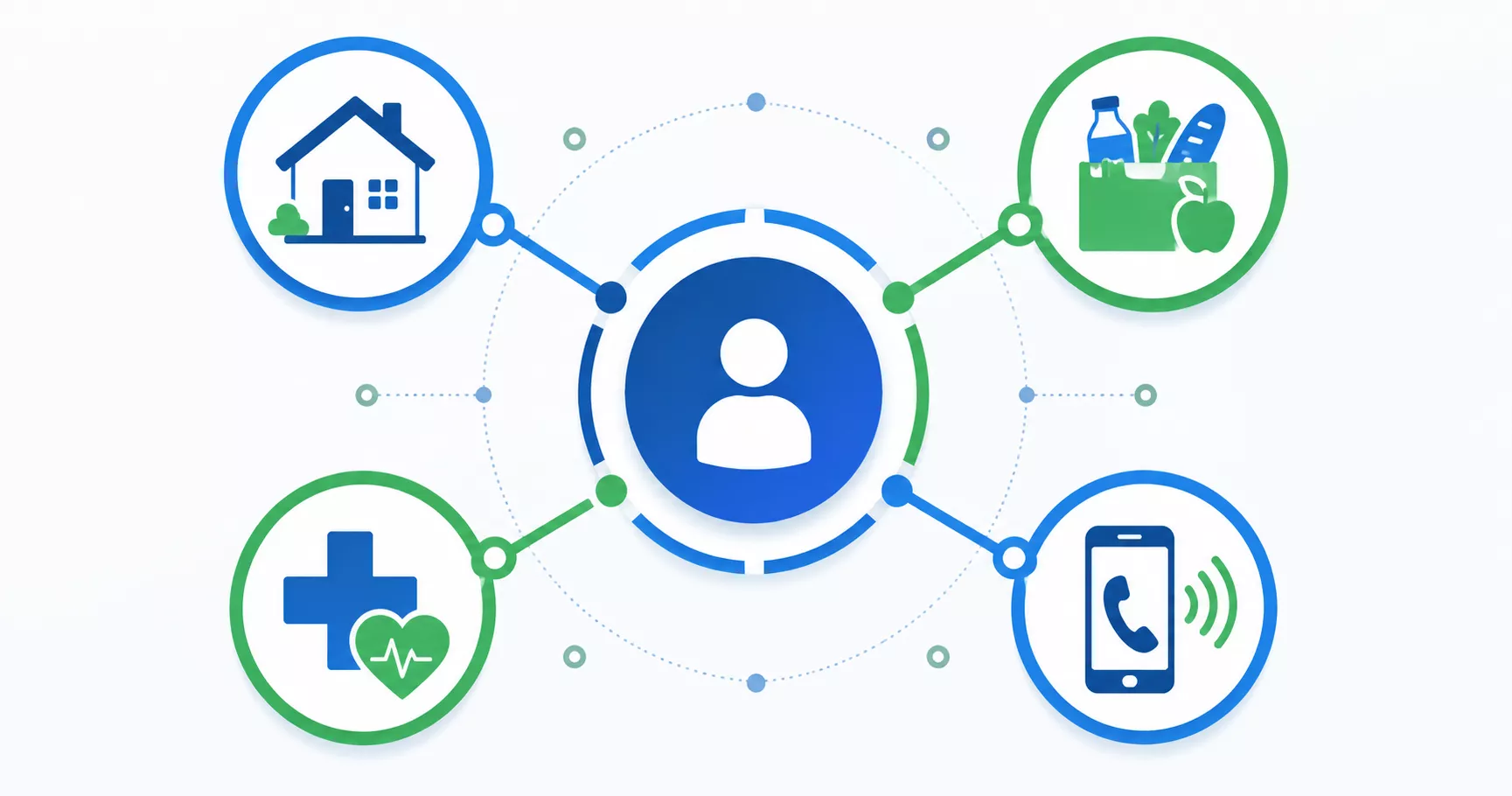
Most people only find out about one benefit program at a time — usually after a friend mentions it or a crisis forces the search. The reality is that these programs are deeply interconnected: qualifying for one often means you automatically qualify for several others. This guide maps out every major federal assistance program available in 2026, how they connect to one another, and where to go for full details on each.
The Big Picture: One Number Connects Almost Everything
Nearly every program on this list bases eligibility on a percentage of the Federal Poverty Guidelines (FPL), published annually by HHS. For 2026, the baseline is $15,960/year for one person and $33,000/year for a family of four in the 48 contiguous states (Alaska and Hawaii use higher figures).
Different programs simply draw the line at a different percentage of that same number:
| Program | Income Threshold | Annual Limit (1 Person, 2026) |
|---|---|---|
| SNAP (net income test) | 100% FPL | $15,960 |
| SNAP (gross income test) | 130% FPL | $20,748 |
| Lifeline | 135% FPL | $21,546 |
| Medicaid (expansion states) | 138% FPL | $22,025 |
| LIHEAP | ~150% FPL (varies by state) | ~$23,940 |
| WIC | 185% FPL | $29,526 |
| TANF | ~50% FPL or less (varies heavily by state) | Often under $8,000 |
For the full breakdown of how these thresholds work and interact, see our complete SNAP & Lifeline income limits guide.
Food & Nutrition Assistance
SNAP (Food Stamps/EBT)
The largest food assistance program, providing a monthly EBT card for groceries. Covers most working-age and elderly adults regardless of family structure. See our guides on the EBT payment schedule, checking your balance, replacing a lost card, and shopping online with EBT.
WIC (Women, Infants, and Children)
For pregnant women, new mothers, infants, and children under 5. Uses a more generous 185% FPL threshold than most programs, and automatic qualification applies if you already receive Medicaid, SNAP, or TANF. Full details in our WIC eligibility guide.
Cash Assistance
TANF (Temporary Assistance for Needy Families)
Flexible cash assistance for families with children — usable for rent, utilities, transportation, or virtually any household need, unlike SNAP’s food-only restriction. Has the strictest income limits of any major program (often 50% FPL or lower) and a hard 5-year lifetime cap. See our complete TANF guide.
SSI (Supplemental Security Income)
Monthly cash payments for people who are elderly (65+), blind, or disabled with limited income and resources — $994/month for individuals, $1,491/month for couples in 2026. Unlike TANF, there’s no time limit and no requirement to have children. Full breakdown in our SSI eligibility guide and SSI payment schedule.
Healthcare
Medicaid
Free or low-cost health coverage, with eligibility largely determined by whether your state expanded coverage under the ACA. In the 40 expansion states plus D.C., adults qualify at 138% FPL with no asset test. In the 10 non-expansion states, healthy adults without children often can’t qualify at all, regardless of income. Full details, including the “coverage gap” problem, in our Medicaid eligibility guide.
Housing & Energy
Section 8 (Housing Choice Voucher Program)
Rental assistance paid directly to your landlord, letting you choose housing in the private market rather than living in government-owned public housing. The honest reality: waitlists in major cities can exceed 10 years, and many are currently closed to new applicants. See our Section 8 guide for waitlist strategy and preference categories that can help.
LIHEAP (Low-Income Home Energy Assistance Program)
Helps cover heating and cooling bills, typically applied as a credit to your utility company bill. If you already receive SNAP, SSI, or TANF, you’re usually automatically eligible without separate income verification. Full details in our LIHEAP guide.
Communications & Internet
Lifeline
Federal discount of up to $9.25/month on phone or internet service, the gateway program behind most “free government phone” and “free government hotspot” offers. See our complete Lifeline Program guide, plus specific guides on free government hotspot devices, comparing hotspot hardware, free government phones, and free tablets.
Beyond Lifeline
If your income is slightly too high for Lifeline, don’t assume you’re stuck paying full price — see our guides on free internet for low-income households and cheap internet options without Lifeline for alternatives with more generous thresholds.
The Most Important Thing to Understand: Categorical Eligibility
This is the single biggest thing most people miss. If you’re already approved for one of these programs, you often qualify automatically for several others without a separate income calculation:
SNAP enrollment → Often auto-qualifies you for: Lifeline, LIHEAP, WIC
Medicaid enrollment → Often auto-qualifies you for: Lifeline, WIC
SSI enrollment → Often auto-qualifies you for: Medicaid (in 34 states), Lifeline, LIHEAP
TANF enrollment → Often auto-qualifies you for: LIHEAP, WIC
This is called categorical eligibility, and it exists specifically so households don’t have to prove their income five separate times for five related programs. If you’re enrolled in any program on this list, it’s always worth checking the others — bring your enrollment award letter to speed up the process.
Quick Decision Guide: Where Should You Start?
| Your Situation | Start Here |
|---|---|
| Need help affording groceries | SNAP |
| Pregnant, or have a child under 5 | WIC |
| 65+, blind, or disabled with limited income | SSI |
| Need health coverage | Medicaid |
| Struggling with rent | Section 8 (expect a wait) |
| Can’t afford your utility bill | LIHEAP |
| Have children and need flexible cash help | TANF |
| Need affordable phone or internet | Lifeline |
Applying for Multiple Programs at Once
Many states let you apply for several programs through a single application or portal — for example, when you apply for SNAP or TANF, most states let you simultaneously apply for Medicaid and check WIC eligibility in the same visit. Ask your caseworker directly: “What else might I qualify for?” — this single question often uncovers benefits people didn’t realize existed.
A Word on Scams
Every program covered on this site is free to apply for. Across our research, one pattern comes up again and again: sites and callers claiming they can guarantee approval, speed up your application, or require payment before verifying eligibility. Legitimate government programs:
- Never require payment to apply or check eligibility
- Never ask for your SNAP/EBT PIN or full bank login credentials
- Always verify your eligibility before offering anything, not after collecting payment
If something feels off, go directly to the official .gov site or your local agency rather than a third-party site that found you through an ad.
Frequently Asked Questions
Can I receive multiple programs at the same time? Yes, in almost all cases. Receiving SNAP doesn’t disqualify you from Medicaid, and receiving TANF doesn’t affect your SSI eligibility. These are separate systems designed to work together, not against each other.
Does receiving one benefit reduce another? Occasionally, yes — for example, TANF cash counts as income when calculating your SNAP benefit amount, which can modestly reduce it. But this is the exception, not the rule; most programs don’t interact this way.
I got denied for one program — should I bother applying for others? Yes. Each program has different rules, and a Medicaid denial (for example) says nothing about your SNAP or Lifeline eligibility, which use entirely different criteria.
Which program should I apply for first if I’m not sure where to start? If you’re already receiving any federal benefit, start there and ask your caseworker what else you might qualify for — categorical eligibility often makes the second and third applications much faster than the first.
Do these programs affect my taxes? Most don’t count as taxable income (SNAP, WIC, TANF, Section 8, and Medicaid benefits generally aren’t taxed), though it’s worth confirming your specific situation with a tax professional if you’re unsure.
Final Thoughts
The federal assistance system in the U.S. isn’t a single program — it’s roughly a dozen separate systems that share overlapping eligibility rules, which is exactly why so many people miss benefits they actually qualify for. The fastest way to find out what you’re eligible for isn’t guessing based on assumptions about your income — it’s checking the specific thresholds for each program (many are more generous than people expect) and asking directly whether your existing enrollment in one program automatically qualifies you for another.
This article is for informational purposes only and is not affiliated with any federal or state government agency. Program rules, income limits, and eligibility criteria change periodically and vary by state — always verify current details directly through the official program website or your local benefits office.

Hotspot Research Team covers free and low-cost internet assistance programs across the United States, including Lifeline, government-supported hotspot devices, and related benefits like SNAP, Medicaid, and SSI. The team focuses on researching official government sources and verified provider information to deliver clear, accurate, and up-to-date guidance for low-income households, students, and remote workers seeking affordable connectivity. Every article is reviewed and updated regularly to reflect current eligibility rules and program changes.